Why Solarpunk Is Already Happening in Africa
Skander Garroum
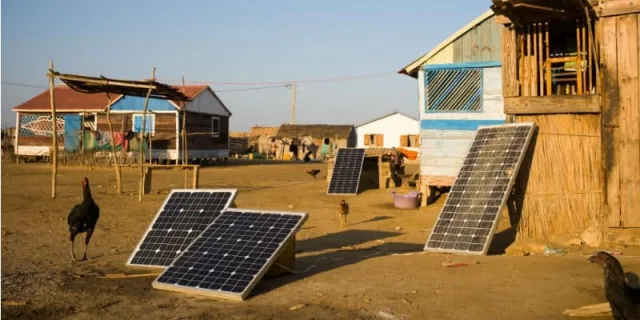
Across Sub-Saharan Africa, private startups are rolling out millions of pay-as-you-go solar systems that bypass slow, costly grid expansion. Cheap panels, mobile payments, and carbon credit financing make small solar kits affordable and scalable for farmers and households. This distributed, digitally monitored model is creating fast, local infrastructure and could be the template for global development.
16 Nov 2025
The grid that never came turned out to be a blessing**.** While development experts spent 50 years debating how to extend 20th-century infrastructure to rural Africa, something more interesting happened: Africa built the 21st-century version instead.
Modular. Distributed. Digital. Financed by the people using it, subsidized by the carbon it avoids.
The solarpunk future isn’t speculative fiction.
This broke open a financing model that changes everything: Pay-As-You-Go.
Chapter 3: Turning Products Into Services: The PAYG Breakthrough
This is the unlock. This is the thing that makes everything else possible.
Here’s the model:
A company (Sun King, SunCulture) installs a solar system in your home
You pay ~$100 down
Then $40-65/month over 24-30 months
The system has a GSM chip that calls home
No payment = remotely shut off
Keep paying = keep power
After 30 months = you own it, free power forever
The magic is this: You’re not buying a $1,200 solar system. You’re replacing $3-5/week kerosene spending with a $0.21/day solar subscription (so with $1.5 per week half the price of kerosene) that’s cheaper AND gives you better light, phone charging, radio, and no respiratory disease.