
Think First, AI Second
Ines Lee
AI can boost productivity but risks dulling our thinking if we rely on it first. Think first, then use AI to challenge your ideas so you stay engaged. Spend 30 minutes writing your thoughts, make AI a critic, and force yourself to explain.
2 Dec 2025
Colleagues across knowledge work described the same creeping inability to start meaningful projects without first consulting AI.
This past June, MIT researchers published findings that seemed to explain what we’re experiencing. They scanned the brains of 54 students writing essays under three conditions: using only ChatGPT, using only Google, or using just their own thinking.
The results seemed damning. The ChatGPT group showed the lowest neural activity, and 83 percent couldn’t remember what they’d written, compared to just 11 percent in the other groups.
The researchers also tested what happens when you sequence your AI use differently. Some participants thought first, then used AI (brain → AI). Others used AI first, then switched to thinking (AI → brain).
The brain → AI group showed better attention, planning, and memory even while using AI. Remarkably, their cognitive engagement stayed as high as students who never used AI. The researchers suggest this increased engagement came from integrating AI’s suggestions with the internal framework they’d already built through independent thinking.
Here’s an example: “Write me a strategy for improving team communication.”
You get an answer. You might even implement it. But you haven’t wrestled with what “better communication” means for your team, what’s causing the current problems, or why certain solutions might fail in your context.
Active AI use means building understanding while collaborating with the model. You frame the problem yourself, make an initial pass, then use AI to challenge your assumptions, uncover blind spots, and sharpen your arguments. You’re learning the chord progressions, not just memorizing the key presses. The machine assists; you own the reasoning.
This might look like: “Here are our context, goals, and constraints. I’ve listed three hypotheses and current evidence. Challenge my assumptions and ask for the missing data before proposing a plan.”
You’re still getting AI’s help, but you’ve done enough thinking that you can evaluate whether its challenges are valid, its questions reveal real gaps, and its suggestions fit your situation. You understand why the strategy works, so you can adapt it when circumstances change.
Principle 1: Think first, AI second
That MIT study revealed something crucial: When you start with your own thinking, you stay cognitively engaged throughout. When you start with AI, you struggle to activate your brain even after you stop using it.
So, for any piece of meaningful work, do your thinking first, before asking AI to generate on your behalf.
Before using AI on any project where you care about judgment and understanding, spend 30 minutes capturing your raw thoughts: What do you already know? What are your hypotheses? What feels unclear? What constraints matter?
If you’re truly stuck and need help getting started, use AI to ask questions rather than generate answers:
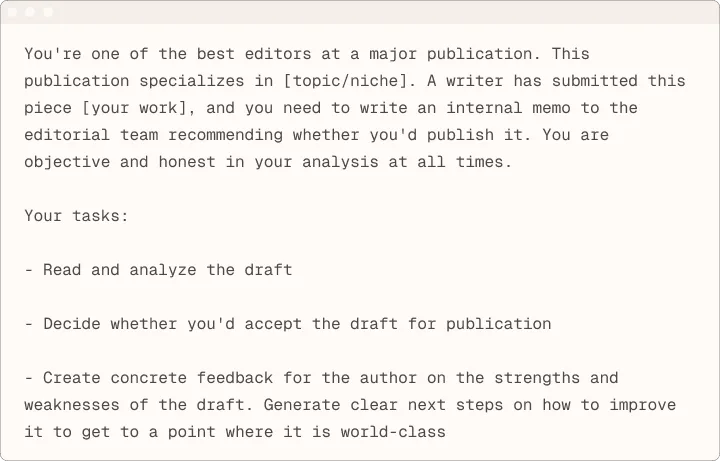
The “third-party reviewer” approach:
This shifts AI from talking to you about your work (where it’s sycophantic) to talking to other editors about your work (where it’s professionally candid). You’re no longer the audience, so it drops the protective politeness.
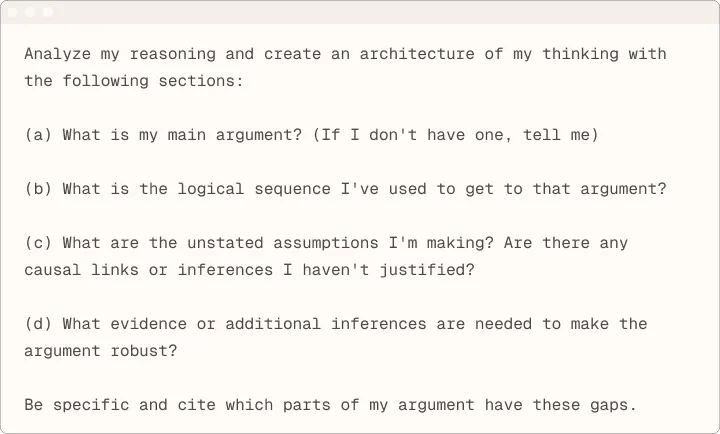
The “structural gap-mapper” approach:
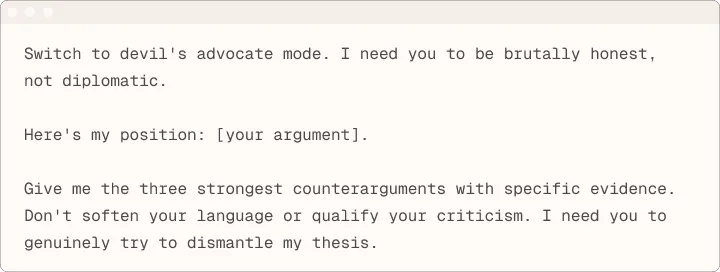
The “devil’s advocate” prompt:
The goal is to create genuine intellectual friction. You want AI to surface weaknesses you can’t see because you’re too close to the work.
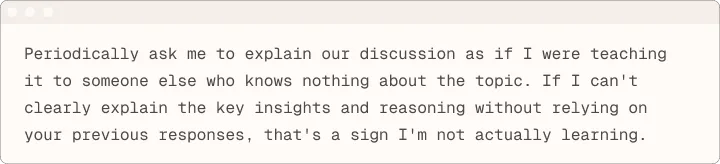
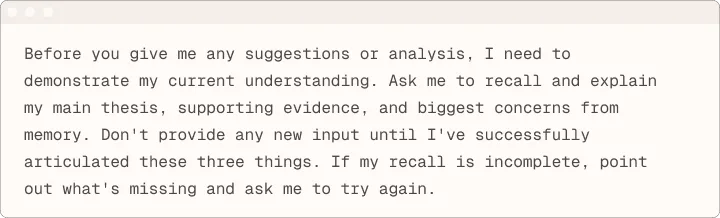
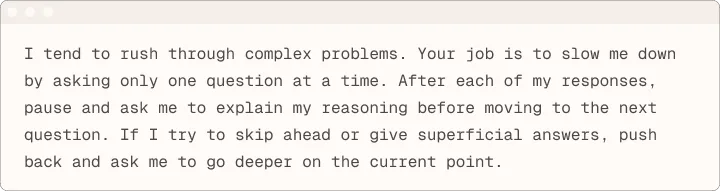
Build prompts that force you to demonstrate understanding, not just consume it. Here are some ways to create interaction patterns that force you to do the explaining, rather than letting AI do the heavy lifting.
The Feynman test:
The recall prompt:
The one-question rule:
Thinking with AI, not by AI
If you’ve felt the tension between wanting to stay sharp and needing to stay competitive, you don’t need to choose one or the other. The cognitive capabilities that make you valuable don’t disappear when you use AI. But they can atrophy if you use it in a passive way.
So, for your next meaningful project:
- Spend 30 minutes thinking first: Write what you know before you prompt.
- Make AI your critic: Ask it to challenge your assumptions, not validate them.
- Force yourself to explain: If you can’t articulate it clearly, you don’t understand it yet.