The Truth About Mental Models With Shane Parrish
Dan Shipper and Kieran O‘Hare
Farnam Street’s founder talks about learning loops, how to read, and how to avoid bullshit
19 Jun 2023
Before you start reading a new book, take out a blank sheet of paper. Write down the basic scaffolding of everything that you already know about the book or its subject—make a rough mind map, if you will. Then you read a chapter or two.
An important point: if you don't know anything at all about what the book is about, you can start reading with a completely blank sheet. Maybe it's the first book you've ever read on this person or subject, so you’ll begin by borrowing the author’s scaffolding.
When you're finished with that first reading session, the second step is to take a few minutes to add the new things you’ve just learned to that sheet of paper, but with a different colored pen this time—so you can tell the difference between your old knowledge and new. Then fold your sheet up and put it inside the book.
You end up with a sheet of paper for every book you read. Say you read thirty books a year, and you do that for ten years. You’ll end up with three hundred of these sheets.
The first reason this works so well is that it primes your brain for what you're about to read. You begin by searching your memory to write out what you think you know about a subject.
The second is that it reinforces that you're learning and connects to what you already know– you're seeing different colors on the page as you add to your existing knowledge. You started out with your own scaffolding of knowledge, and now you're adding to it. Sometimes you’ll erase what you think you know that just isn’t so.
Third, it gives you an easy-to-read sheet that you can save for future reference.
I keep them all in a binder—in fact I have a bunch of binders at this point—and every six months or so I’ll take an afternoon and go through them all. It could be on a day when I'm just trying to think, or when I'm stuck writing something and I want to take my mind off of it.
Best of all, though, it will help you connect ideas across domains, and you’ll see things that others don’t. You’ll be able to make connections between ideas that never occurred to you before.
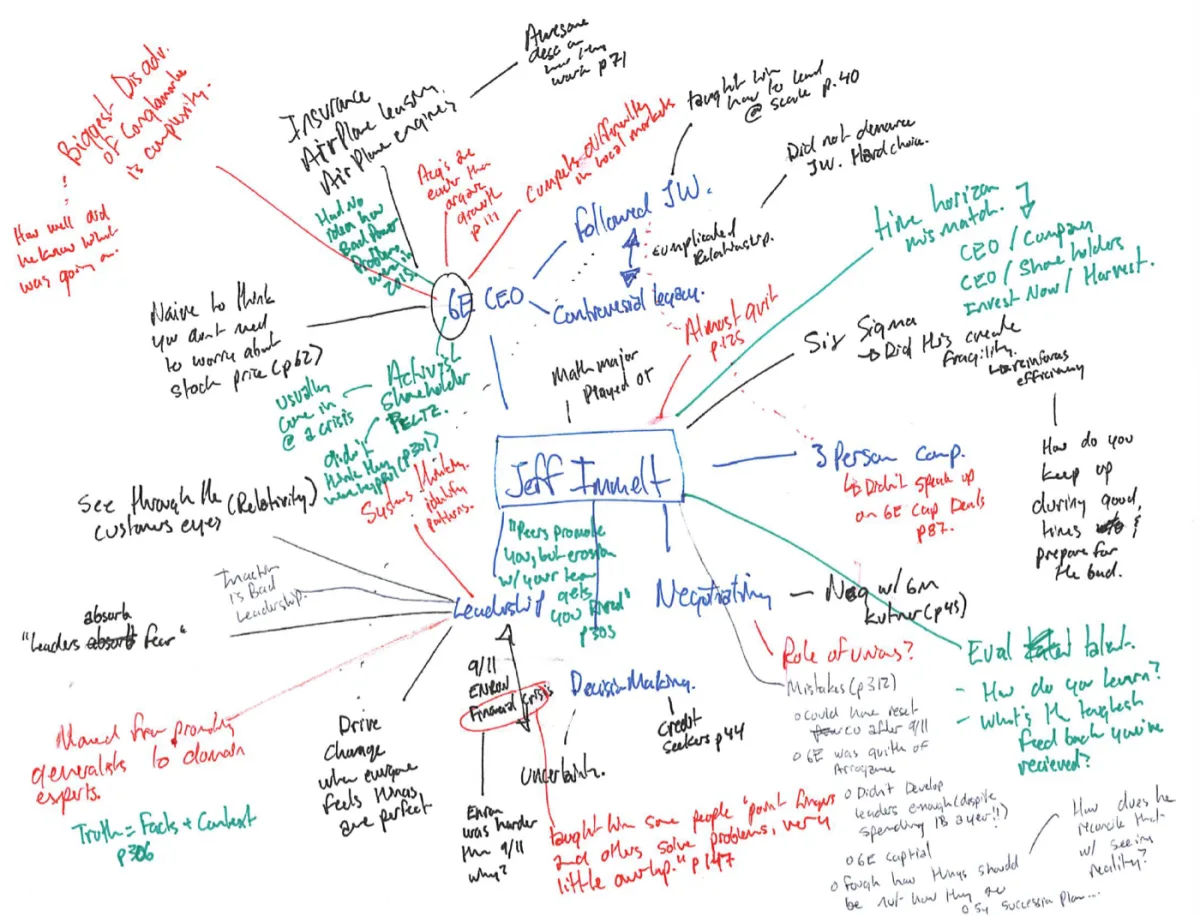
The Blank Sheet in action
Here’s a sheet I made when I was reading a new book by Jeff Immelt—someone whom I was preparing to interview for The Knowledge Project. This is how I did my research.
I keep a decision journal as a way to really calibrate how I make my decisions. I advocate them for everyone. It’s a way of approaching decision-making with foresight, that allows me to be incredibly honest and vulnerable with myself.
Decision journals help you … reflect. And reflection is the key to learning.
Here’s what you do. You make a decision about something, and you write it down—in your own writing, not on a computer—along with all the reasons why you’ve made it.
You try to keep track of the problem you’re trying to solve for and its context, what you expect to happen and why, and the possible complications. It’s also important to keep track of the time of day that you’re making the decision, and how you’re feeling.
Then you sleep on it. Don’t tell anyone. Just sleep on it.
When you wake up fresh in the morning, you go back to the journal, read what you were thinking, and see how you feel about what you decided.
What you’re doing is slowing down. You’re not implementing your decisions immediately, based solely on intuition or instinct—you’re giving yourself that night of sleep to dampen the emotions around certain aspects of the decision, and perhaps to heighten others. You’ll be able to filter what’s important from what isn’t so much more effectively.