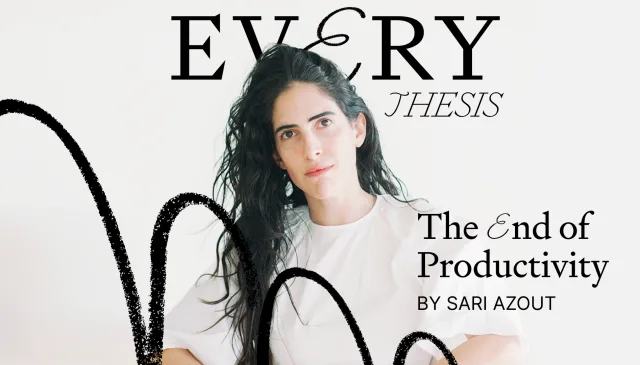
The End of Productivity
Sari Azout
Sari Azout argues that we should prioritize creativity over traditional productivity metrics, especially as AI advances. She emphasizes the need for tools that foster creative thinking by allowing for exploration and connection rather than just efficiency. The shift from productivity to creativity is essential for a more fulfilling and meaningful work life.
20 Nov 2024
Information that is worth saving usually falls into two buckets:
• Administrative information: The daily minutiae of our lives (e.g., grocery lists, meeting notes, to-do lists) • Creative information: Information that fuels our projects and ideas (e.g., that perfect quote for a presentation, the scientific study that inspires your next big essay, the podcast episode that sparks a new business idea)
For administrative information, a search bar or hierarchical folder structure is sufficient. When you’re locating your child’s health insurance forms or retrieving your tax returns, you want efficient, predictable retrieval—not exploration.
But for creative information, what you need is tools that encourage connections, facilitate serendipity, and support non-linear thinking. If you think of tools as places where you spend your time, then Linear is a factory production line, Asana a conveyor belt, Evernote an office cubicle, and X an overcrowded bar. A tool built for creativity should feel like a sunlit artist’s studio—spacious and inspiring, with windows you can open to allow the unexpected in.
Most tools for capturing information force you to choose between one mode and the other. PKM tools like MyMind (which Dan has explored) highlight the convenience of one-click capture. They’re perfect for foraging, as you can use them to save something without having to decide where it belongs, but not particularly helpful for organizing and connecting ideas. Meanwhile, tools like Are.na, Evernote*,* and Notion force you to immediately decide where a piece of information belongs. This is great when you’re in hunting mode, but not when you have yet to figure out how something might be useful.
To do our best creative thinking, we need tools that seamlessly support both modes. We should be able to capture ideas effortlessly in the moment, then organize them with purpose when the time is right. This balance between seamless capture and intentionality is essential for supporting creativity.
Most tools treat consuming and creating as distinct processes. You compile sources for a book in a note-taking app, but type in a blank page in a different window, on a different platform.
Speaking from personal experience, however, it feels clear that for our brains, the act of reading and reflecting on a book is not all that different from the act of writing one. In both cases, we are seeking out novel connections, combining existing concepts to produce new ones. So why do we think of the act of consuming, as opposed to producing, as inherently passive? Why do we write in an empty Google Doc, detached from everything that has inspired us to write? Why are we expected to gather ingredients in one kitchen and cook in another?
At Sublime, this is already happening. While writing this essay, any time I found myself wrestling with how to articulate a concept, I would select a sentence and press ctrl+r. Using AI, Sublime would instantly pull up related ideas from both my own library and that of others in the network—including the Austin Kleon reference I included earlier.
The AI didn’t generate the output for me. It surfaced just-in-time quotes to reinforce my argument, rescue me from my own forgetfulness, and push me to make the occasional creative leap.
Ultimately, moving away from productivity and toward creativity isn't just an economic necessity, something we need to stand out in the marketplace; it's about reclaiming our humanity and building more fulfilling lives. The goal can’t just be making more stuff. It has to be making something wonderful.