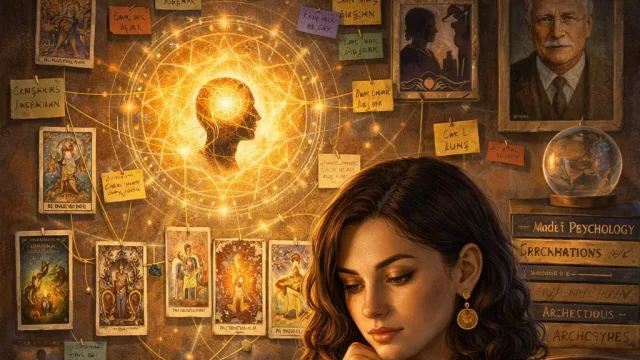
Tarot as a Psychological Tool
Alan Jones
Tarot cards are not magical but serve as tools for psychological self-examination. They use random images to help people reflect on their feelings and life stories. This method encourages new insights by asking questions that challenge usual thinking.
7 May 2026
“A tarot card is a Rorschach blot with better production values and a stronger narrative tradition. The ink blot asks: What do you see? The tarot asks: What does this mean for you? The second question is considerably more useful.”
Each of those responses is a projection. And each projection is data about the person’s current emotional state, their habitual narratives, their relationship with adversity, and the stories they tell themselves about suffering and survival. The card did not cause these responses. It invited them. The distinction is important, and it is the entire point.
There is a well-established phenomenon in creativity research sometimes called the paradox of choice: the observation that unlimited options frequently produce paralysis, anxiety, and worse decisions than a constrained set of possibilities. Barry Schwartz documented this extensively in his 2004 book of the same name. When everything is possible, nothing feels right, because the cost of choosing one thing is the loss of every other thing, and that loss feels permanent.
A tarot reading introduces productive constraint. You drew these cards, not those cards. These specific images, in these specific positions, represent the frame within which you are being asked to think about your situation. This is not a limitation. It is a liberation. Instead of facing the open ocean of all possible ways to think about a problem, you are given a specific inlet; navigable, bounded, with a particular character. The constraint directs attention in ways that unconstrained reflection frequently fails to.
Poets know this. Sonnets work not despite the constraint of fourteen lines and a rhyme scheme, but because of it. The form forces particular choices, particular compressions, particular connections that would never have been made in free verse. The tarot spread is, in a very real sense, a thinking form a structured constraint that produces insights that open-ended rumination does not.
The randomness is not a flaw in the mechanism. It is the mechanism. Here is why.
When you draw a random card and are told it represents your current situation, you do not simply stare at it and wait for information to arrive. You engage with it. You ask, actively and often urgently: how does this apply to me right now? That question — forced by the combination of the card’s meaning and the position in which it was drawn — searches your actual experience for relevant material. The search is real. The material it retrieves is real. The connection you make between the card and your life is real. The card itself is random, but the psychological activity it prompts is anything but.
This is closely related to what psychologists call the generation effect: the well-replicated finding that information we generate ourselves is remembered more effectively and processed more deeply than information we receive passively. A therapist who tells you something about yourself is useful. But you arriving at the same insight yourself — prompted by a question, a card, an image, a conversation — is considerably more powerful, because the insight is now genuinely yours.
Tarot used predictively asks: what will happen? Tarot used psychologically asks: what is happening in me right now, and what might I be failing to see about it? The second question is the useful one, because it is answerable. Nobody knows what will happen. You know rather more than you think about what is happening in you — but that knowledge is often buried under habitual narrative, defended against by ego, or simply not translated into language yet.
Good questions for a rational tarot practice include: What am I not allowing myself to see about this situation? What am I afraid this decision means about me? What story am I telling myself that might not be accurate? What am I avoiding, and what is the avoidance protecting? What would I advise a friend who brought me this situation? These questions are useful with or without tarot. The cards make them harder to dodge.
Used this way, tarot is not fortune-telling. It is a structured form of self-examination — one that uses the richness of symbolic imagery, the productivity of constraint, the mechanics of projection, and the surprising power of the random question to access parts of the mind that direct introspection frequently misses. It requires no supernatural claims. It produces real psychological value. And it is considerably more interesting than it looks from the outside.
You do not have to believe in anything supernatural to use it. You do not have to abandon your scepticism, your scientific training, or your well-developed sense of the ridiculous. You just have to be willing to sit with an image, ask a genuine question, and pay attention to what comes up.
Which is, when you think about it, what good therapy asks you to do. The cards just have nicer pictures.