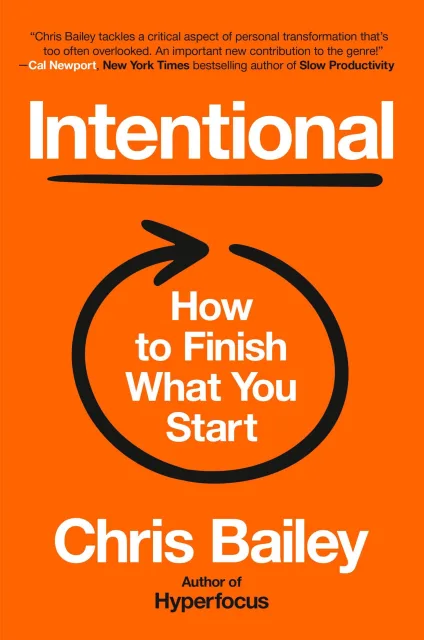
Intentional
Chris Bailey
Setting goals with clear intentions helps us control our actions and grow beyond old habits. Aligning goals with our personal values makes us more motivated and productive. By reflecting on our goals and managing desire and aversion, we can make steady progress and find more meaning in our daily actions.
15 Jan 2026
“We look at the world once, in childhood. The rest is memory.”
—Louise Glück[1]
My favorite way to do this is to keep an “accomplishments list.” The definition is in the name: It’s a list of everything you’ve accomplished. You can keep the list across whatever timeline you’d like. If you find yourself dragging your heels to get things done throughout the week, capture the things, large and small, that you accomplish throughout that week to review alongside your intentions. If you instead prefer to reflect on the larger results of your labor, update a list of the results your efforts have led to—at work and at home—throughout the year. I prefer to keep the yearly list, and often also keep a weekly list when I’m feeling especially unmotivated. Like a well-structured goal, both lists are great motivational propellant.
The best way I have found for noticing (and taking greater advantage of) our default intentions is by practicing mindfulness.
16 Jan 2026
But it is critical to mention here that there is immense power in letting your mind roam free—wherever it wants to go—when you hit an impasse with something. Sometimes, a fifteen-minute walk produces greater insight than focusing on a problem for several hours.
We think about our goals fourteen times more often when our mind is wandering compared with when we’re focused.[10] Wandering looks unproductive, but when done deliberately, it is truly a way we can double down on goal attainment—while solving more problems.
The twelve fundamental values we all share (in different amounts), as first uncovered by professor and researcher Shalom Schwartz, are:
• Self-direction: Choosing and cultivating your own thoughts, ideas, and actions
• Stimulation: Having novelty, excitement, and challenge in your life
• Pleasure: Enjoying hedonistic pleasure, especially through your five senses
• Achievement: Attaining success, whether by your own standards or the standards of others
• Power: Controlling material resources, social resources, or other people
• Face: Preserving your own image and avoiding humiliation
• Security: Finding safety and stability both in your environment and in society at large
• Tradition: Appreciating, preserving, and maintaining cultural, familial, and religious customs and rituals
• Conformity: Abiding by rules, obligations, and expectations while restraining actions that may harm or upset others
• Humility: Understanding your insignificance in the grand scheme of things, while believing you are a part of something greater than yourself
• Universalism: Understanding, appreciating, and protecting the welfare of people and nature
• Benevolence: Being a devoted and reliable member of the groups you are in
Each of these values either fits into one of the polarities or sits on the dividing line between them. To determine your orientations, you can ask yourself the following two questions.
The first: Would I prefer if things stayed the same or would I prefer if they got better?
If, on balance, you want things to stay as they are, you may feel more of a desire to live up to the expectations and obligations others have of you—valuing conformity. You may desire stability and safety in your life—valuing security. You might also be more inclined to love rituals like gathering with family and friends during holidays—valuing tradition. Conversely, if you would generally prefer that things improved across the ways in which you relate to the world, you may instead value thinking for yourself and going your own way—valuing self-direction. You are also more likely to enjoy excitement and novelty—valuing stimulation.
Of course, our values are not black and white: You likely fall somewhere between these two extremes. Broadly speaking, there is safety, security, and comfort to be found in things remaining predictable; tangible gains and excitement are to be found in things improving for the better. Which of these factors wins out for you is related to which more specific values will be strongest for you.
17 Jan 2026
It should come as no surprise that with such basic motivations at its foundation, Schwartz’s model stands up across people and across cultures. To date, the circular model has been supported by research on more than three hundred samples in more than eighty countries and has been found to be valid for children as young as five years old. As Schwartz put it, the very structure of our values “suggests that there is a universal organization of human motivations.”[6]
18 Jan 2026
If you want to get more granular, scientific, and accurate, you can also take a comprehensive values test. Because a values test would be too long for this book, I posted one to the book’s website, at chrisbailey.com/intentional. This test has to live online for a couple reasons. First, it’s a long test, and scoring for it is a bit complicated. Second, and more important, I very unfortunately have to pay a licensing fee each time the test is taken, so taking the test has to cost a small fee (or else I would lose a fortune).
19 Jan 2026
To date, there have been thousands of studies published on the psychology of goal attainment. The SMART acronym is unfortunately not only not supported by this research, it often contradicts it. For example, research recommends that we set challenging, difficult goals—this makes us more likely to achieve more. The SMART acronym does the opposite by focusing on goals that are instead Achievable and Realistic.
Your capacity to focus each day is limited—and focusing on complex things all day long can be a recipe for exhaustion after a while. While we’re all different, and we all do different types of work, generally speaking, we have around four focused hours in us every day. For this reason, I’ll typically limit my daily “deep work” time to four or four and a half hours (including during my time blocks, chapter 7)—doing admin work and less cognitively intense work outside of that time. This way, I can respect my daily focus limit and make sure my productivity level stays sustainable in the long run—while ensuring ample time for simpler tasks and breaks in between. Running past this can compromise our productivity both in the short and long run.
25 Jan 2026
To make a goal inventory, write down all the current goals you’re working toward. Don’t think too hard about them—just get them out of your head and write down all that you can possibly think of. Capture everything: goals large and small, short and long, meaningful and meaningless. When you hit a point where you can’t think of any more, keep the list somewhere visible that you can easily access—like as a file on your computer’s desktop or a sheet of paper on your desk. This way you can remember to write down anything you missed. The key is to get everything out of your head so you can begin planning your goals logically.