Dopamine Nation: Finding Balance in the Age of Indulgence
Anna Lembke
"Dopamine Nation" by Anna Lembke explores how understanding addiction can help us find a healthy balance between pleasure and pain. The book shares true stories of patients overcoming addiction, highlighting their lessons and experiences. It emphasizes the importance of addressing both neuroscience and personal stories in the journey to recovery.
7 Apr 2025
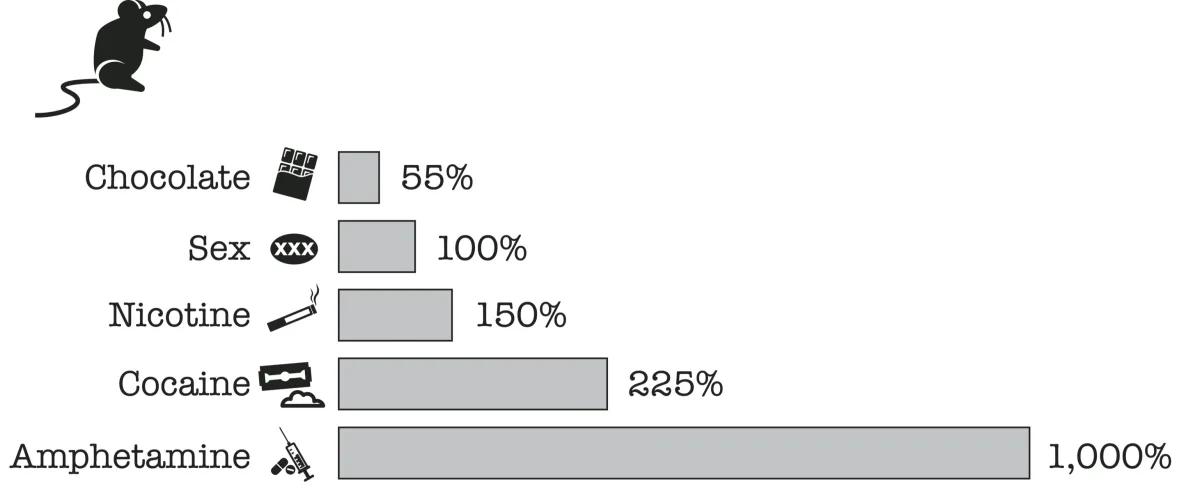
Dopamine is not the only neurotransmitter involved in reward processing, but most neuroscientists agree it is among the most important. Dopamine may play a bigger role in the motivation to get a reward than the pleasure of the reward itself. Wanting more than liking. Genetically engineered mice unable to make dopamine will not seek out food, and will starve to death even when food is placed just inches from their mouth. Yet if food is put directly into their mouth, they will chew and eat the food, and seem to enjoy it.
With repeated exposure to the same or similar pleasure stimulus, the initial deviation to the side of pleasure gets weaker and shorter and the after-response to the side of pain gets stronger and longer, a process scientists call neuroadaptation.
We’ve all experienced the letdown of unmet expectations. An expected reward that fails to materialize is worse than a reward that was never anticipated in the first place.
How does cue-induced craving translate to our pleasure-pain balance? The balance tips to the side of pleasure (a dopamine mini spike) in anticipation of future reward, immediately followed by a tip to the side of pain (a dopamine mini deficit) in the aftermath of the cue. The dopamine deficit is craving and drives drug-seeking behavior.
12 Apr 2025
The brain encodes long-term memories of reward and their associated cues by changing the shape and size of dopamine-producing neurons. For example, the dendrites, the branches off the neuron, become longer and more numerous in response to high-dopamine rewards. This process is called experience-dependent plasticity. These brain changes can last a lifetime and persist long after the drug is no longer available.
27 Apr 2025
For decades the wisdom of Alcoholics Anonymous dictated that abstinence is the only option for people with addiction.
But emerging evidence suggests that some people who have met criteria for addiction in the past, especially those with less severe forms of addiction, can return to using their drug of choice in a controlled way. In my clinical experience, this has been true.
30 Apr 2025
As one patient put it, “With disulfiram, I only need to decide once a day not to drink. I don’t have to keep deciding all day long.”
Some people, most commonly East Asians, have a genetic mutation that causes them to have a disulfiram-like reaction to alcohol without the drug. These individuals have historically had lower rates of alcohol addiction.
One in four gastric bypass surgery recipients develops a new problem with alcohol addiction. In the wake of her surgery, Emily too became addicted to alcohol. The reasons are many.
Most people who are obese have an underlying food addiction, which is not adequately addressed with surgery alone.
Cigarette smokers are more likely than matched controls to discount monetary rewards (that is, they value them less if they have to wait longer for them). The more they smoke, and the more nicotine they consume, the more they discount future rewards.
In today’s dopamine-rich ecosystem, we’ve all become primed for immediate gratification. We want to buy something, and the next day it shows up on our doorstep. We want to know something, and the next second the answer appears on our screen. Are we losing the knack of puzzling things out, or being frustrated while we search for the answer, or having to wait for the things we want?
13 May 2025
My patient Jasmine came to me seeking help for excessive alcohol consumption, up to ten beers every day. As part of the treatment, I advised her to remove all alcohol from her home as a self-binding strategy. She mostly took my advice, with a twist.
She removed all alcohol save one beer, which she left in her refrigerator. She called it her “totemic beer,” which she regarded as the symbol of her choice not to drink, a representation of her will and autonomy. She told herself that she only needed to focus on not drinking that one beer rather than the more daunting task of not drinking any beer from the vast quantity available in the world.
This metacognitive sleight of hand, transforming an object of temptation into a symbol of restraint, helped Jasmine abstain.
17 May 2025
The ancient Greeks developed a heating system for public baths but continued to advocate for the use of cold water to treat a variety of ailments. In the 1920s, a German farmer named Vincenz Priessnitz promoted the use of ice-cold water to cure all manner of physical and psychological disorders. He went so far as to turn his home into a sanitarium for ice-water treatment.
Unlike pressing on the pleasure side, the dopamine that comes from pain is indirect and potentially more enduring. So how does it work?
Pain leads to pleasure by triggering the body’s own regulating homeostatic mechanisms. In this case, the initial pain stimulus is followed by gremlins hopping on the pleasure side of the balance.
We’ve all experienced some version of pain giving way to pleasure. Perhaps like Socrates, you’ve noticed an improved mood after a period of being ill, or felt a runner’s high after exercise, or took inexplicable pleasure in a scary movie. Just as pain is the price we pay for pleasure, so too is pleasure our reward for pain.
22 May 2025
Among Japanese citizens living outside the epicenter of the 1945 nuclear attack, those with low-dose radiation exposure may have shown marginally longer lifespans and decreased rates of cancer compared to un-irradiated individuals
In humans, high levels of physical activity in junior high, high school, and early adulthood predict lower levels of drug use.
24 May 2025
Scientists have shown that stress alone can increase the release of dopamine in the brain’s reward pathway, leading to the same brain changes seen with addictive drugs like cocaine and methamphetamine.
A study of skydivers compared to a control group (rowers) found that repeat skydivers were more likely to experience anhedonia, a lack of joy, in the rest of their lives.
The authors wrote that “skydiving has similarities with addictive behaviors and that frequent exposure to ‘natural high’ experiences is related to anhedonia.”
6 Jul 2025
Telling the truth draws people in, especially when we’re willing to expose our own vulnerabilities. This is counterintuitive because we assume that unmasking the less desirable aspects of ourselves will drive people away. It logically makes sense that people would distance themselves when they learn about our character flaws and transgressions.
In fact, the opposite happens. People come closer. They see in our brokenness their own vulnerability and humanity. They are reassured that they are not alone in their doubts, fears, and weaknesses