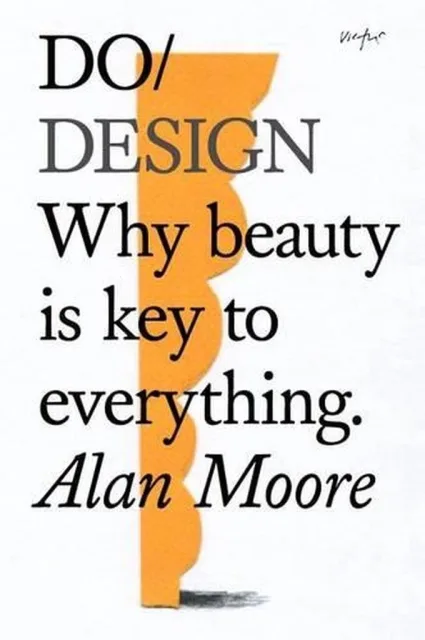
Do-Design-Why-Beauty-Is-Key-to-Everythi-Alan-Moore
Alan Moore
29 Jul 2024
We are all interconnected at the level of atoms. The earth is one system, we are all part of that system and there is a certain unity to it, which also has implications for us all.
‘You see things as you see them with your eyes but you experience them emotionally and viscerally as if it was ecstasy and a sense of total unity and oneness. The molecules in my body and the molecules in my partners’ bodies, and in the spacecraft had been prototyped in some ancient generation’s stars. In other words, it was pretty obvious... we’re all stardust.’
Today we explore ‘supersymmetry’ when searching for the Higgs Boson. Supersymmetry is often described as being too beautiful to be entirely wrong. This elegant theory suggests every elementary type of particle we know of in nature has superpartners, which dance interactively with each other; but for some reason nature has hidden these beautiful exchanges from view. Many believe supersymmetry takes us towards a fully uni ed description of nature at the deepest level. Several of the world’s leading theoretical physicists draw encouragement from its surpassing mathematical beauty and the fact that, for the first time, it explains the very existence of gravity. How beautiful is that?
The purpose of work for the Shakers was as much to benefit the spirit as it was to produce goods. Mastery of craft was a partnership with tools, materials and processes: gaining experience in patience that served the craftsman in many other areas of life. A job well done is not based upon watching the clock or fighting time–but in giving oneself to the task. The Shakers worked both as though they had a thousand years to live and as if they would die tomorrow. Their work transformed common objects into works of uncommon grace. The effort of a Shaker craftsman was dependent not on style but ‘truth’.
The Shakers also had one golden rule–back to William Morris: Do not make that which is not useful. And so it was their interpretation that all useful things should also be beautiful. God, as architect Mies van der Rohe said, was in the details and, you never know, an angel may come one day and sit on that chair–it had to be worthy of such an event.
Engelbart described what it was he wanted to create, even though it did not exist in any form. This is important: if you cannot describe a new destination, you will never get there. You could say, the limits of our language are the limits of our world. A new language enables us to make the transition from where we are now, to where we need to get to. It lets us leap disciplinary boundaries. If we can’t describe it, then we struggle to make it.
It is in truth that we find beautiful things, and it is in truth that we can operate authentically. One might have the head of an engineer, but one must always quest with the heart of a poet.
Curiosity is voracious–the more you know the more you want to know; the more connections you make between the different bits of knowledge; the more ideas you have. Which is why curiosity is really the wellspring of creativity.
Co-founder of Pixar Ed Catmull said, ‘The greatest enemy of creative success is the attempt to fortify against failure.’ If you want to create the future, the new, and the better... you are going to make some glorious mistakes, graze your knees, and feel a little downhearted. But this is the process we all go through to get to create the truly valuable and original.
We instinctively know when the design is right, and when it is horribly wrong. Cast your mind back to the harmonious Shaker chair. There should be a natural resonance and rhythm, as the form blends content, images resonate with text, and text flows from one opening to the next with pleasing aesthetic logic. These things do not happen by themselves. They are the result of care, thought and meticulous attention to detail.
Walk through the front door, smell the warm baking bread that makes a house a home. Feel the cold visceral shock of the ocean as the waves break on your body. Lie in a wild meadow and watch the clouds scud across the sky. Slowly breathe in the scent of summer rain. Pull on your favourite jumper, feel how you enjoy its softness. Take a walk through a wood, listen to the sounds and sense the endless shades of green, witness the shapes of the trees.
Why does art endure? Because it always one way or another speaks directly to our senses. To design for the senses is not weakness but strength. It resists the belief that making a business succeed is only about numerical measurement, the quest for effciency rather than truth found in experience. Who cares? Well, we do, human beings do–the people that use your products and services.
Great design is when you design for others to feel, to experience with their senses, perhaps even to be pleasantly surprised–a joyful experience. This joyfulness converts always into goodwill, warm memories and, if you are so inclined, cash. Some of the most successful recent businesses were founded by designers–adopting their practices could be the best thing you do for your business. We don’t think beauty–we feel it, we sense it, we know it.
The practice of working collaboratively is key to successful outcomes. We need to learn how and why we collaborate, what motivates human beings to give their creative best. I have witnessed its practice in many environments and if it works for anything from a public health authority to a billion dollar company, I believe it can work for you.
Do not work with people who don’t want beautiful, who wish to cut corners to increase profitability. Who, more dangerously, bring neither elegance nor grace to their work and their working environment, but the opposite. Work should be enjoyable and should uplift your spirits as it did the Shakers. Our time on this planet is short, so make it count.
I can look back now on a career, halfway done. And I can say you do not make the best or wisest decisions when you are filled with fear. You don’t make your best work either. My practice is learning to let that fear go. This is easy to say but very hard to do. You have to really believe in what you are doing, you have to work with conviction. You have to be able to back yourself.
Investing in loving what you do always costs time, money, and sometimes the odd scar and bruise. It repays that love with personal satisfaction, and in turn it inspires, guides and nurtures the spirit in others. If we invested in more things that give us a meaningful life, our world might feel a little different. And our work might even outlive us. As a good friend said to me, ‘Invest in love, it pays well in the end.’
We need to understand that humanity is a living system too, deeply interconnected with nature’s systems. We all ride flows of matter, energy and information. So it is absurd to persist in refusing to see our world as being interconnected, attempting to describe it instead as a place to be managed like numbers on an Excel spreadsheet, devoid of meaning, context, community and history. This could be our downfall.
The cynic dismisses the existence of Utopia, preferring the surety of mediocrity, and worse. The wise person is optimistic, prepared for the reality they will not get to the Utopian shore, but keeping its possibility in their sights. Working this way offers a joyful and more meaningful existence. It is a continual process and that is its enduring beauty.
No pessimist ever discovered the secrets of the stars, or sailed to an uncharted land, or opened a new heaven to the human spirit. As you sail along, maybe it’s wise to keep the Utopian coast in your sights.