Culture Studies
Henrik Karlsson
Montessori and Jesuit schools promote distinct cultures that shape their students' learning experiences. While Jesuit education is traditional and hierarchical, Montessori focuses on child-centered exploration and normalization. Both educational models rely on an intentional social hierarchy to reinforce their values, but they differ in their approach to teacher training and cultural commitment.
15 Oct 2024
On August 15, 1534, Ignatius of Loyola and six other students at the University of Paris met in a crypt beneath the church of Saint Denis to pronounce vows of poverty, chastity, and obedience to God. They called themselves the Compañía de Jesús, and (although Ignatius himself never used the word) the members of the order became known as Jesuits. The Jesuits sought to counter the waning influence of Catholicism through missionary work — and by starting schools. These included seminaries for training priests, as well as lower schools (called “colleges”) for younger students, typically aged 12 to 17. They were unusual in the breadth of students they served, providing free education to anyone who passed an entrance exam. Educating the broader population at that scale had never been attempted in Europe before.
The Jesuits did not inherit a culture suitable for learning: they made one. Or rather, they took a small scholarly culture, seeded by themselves (a set of seminary students at the University of Paris), and then figured out how to scale it up. They managed to build institutions where the values and norms promoted self-discipline, scholarly work, submission, and service to the community.
You might think that the serious scholarship Jesuit boys engaged in from a young age reflects the values of a society that elevated learning more than ours, but this was not the case. The culture that Jesuit pupils brought with them to the schools was rather set against learning. As the influential French medievalist Philippe Ariès argued in his Centuries of Childhood, children in the 16th and 17th centuries lived with little separation from the adult world, which by modern standards was rough and anti-intellectual. It was common for young boys to duel, drink, and torture animals as a sport. The essayist Michel de Montaigne, who came of age just before the Jesuit colleges were established, jokes in one of his essays that brothels were frequented more than classrooms: “A hundred scholars have caught the pox before getting to their Aristotle lesson” — that is, by their mid-teens.
Maria Montessori’s vision of childhood was greatly at odds with the Jesuit ideal of strict hierarchy and discipline. She believed that children should have great freedom to choose what to work on and limited structure for how to approach it. Montessori opened her first classroom, Casa dei Bambini (Children’s House), in a tenement building in Rome in 1907. Within a few years, it gained international attention. By 1910, Montessori schools could be found across Western Europe, and in 1911 they spread to the United States. Today, there are more than 15,000 around the world.
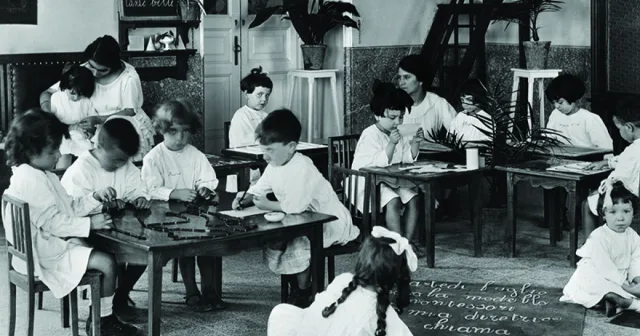
Montessori attempted to arrange the school in such a way that children would be guided to activities designed to support their growth through their own free exploration. The rooms at a Montessori school are not arranged around desks in rows but instead have plenty of open space and separate workstations.
Montessori classrooms require a certain stillness, since the children work independently for long blocks of time on self-chosen projects. This focus, and this capacity to move between tasks without disturbing others, is a cultural norm that children have to pick up. Kids who have attended other schools often need time (and struggle) to adapt, a process Montessori educators call “normalization.” A normalized student is one who has internalized the culture, something Montessori herself described as “the most important single result of our whole work.”
Children who reach the third stage of normalisation have typically attended a Montessori preschool three or more days per week, and are usually between five and six years of age. During this stage of development, children can focus intently on one activity, and then move onto the next activity without disturbing the work of others. Minimal supervision is required, as the children’s work is self-directed, and self-sufficient.
Other characteristics ascribed to a normalized child are a “love of work,” “pursuit of self-mastery,” and “sociability.” On its face, these sound like values most schools endorse. Yet it is not uncommon that visitors from other schools find the focus and silence at Montessori schools “unnatural.”
And the key is this: Once you have established this norm, you can add a new cohort of younger children. They will imitate their older, enculturated peers, since Montessori classrooms are age-mixed.
“While the expression ‘mixed-age’ has become commonplace, what is crucial about such an arrangement is that the older students in a classroom come to serve as models for the behavior of the younger students,” Strong said. “Children are biologically programmed to imitate the behavior of our older peers. There are no actions that an adult can take to rival the effectiveness of older children modeling desired behaviors for younger children.”
Humans preferentially learn from people whom we perceive as competent, successful, or prestigious. Children, perhaps because they are less skilled at telling who is competent, also rely substantially on imitating those who are (slighly) older. By elevating these cultural role models, you can affect the norms of the wider group.
Because of the outsized influence of older students in an age-mixed context, Montessori schools are sensitive to the introduction of students who transfer from normal schools. If more than 10% to 20% of the older students have transferred from other schools, the culture will be perturbed and important norms will be lost. A common example of this is how non-Montessori school children tend to view self-directed time as a chance to socialize, which leads them to speak during the extended periods of self-directed work — a norm that tends to spread, since conversations attract more participants.
Jesuits and Montessori schools both do teacher training in the schools in the form of apprenticeships. Jesuits grew their ranks by employing seminary students who stayed on in the colleges to become scholars. Montessori training consists of a year as an assistant to a mature Montessori teacher, complemented with two summer classes. Normal teacher education also has a component of on-the-job learning, but Montessori and Jesuit training goes further in several ways. First, it is the main part of teacher education, rather than a complement to university classes. Second, there is a stronger emphasis on the master-apprenticeship relationship.
Montessori was, like Loyola, a devout Catholic, and there is a certain religious fervor to her mission (creating world peace through a revolution in education!) and her emphasis on virtues and commitment on the part of teachers. Later lineages of Montessori emphasize this less, but there is still a clear sense that becoming a Montessori teacher requires a moral commitment that normal teaching does not. This focus on stepping into a tradition and accepting it fully, making a moral commitment, likely helps to keep the culture in the schools more stable. 6
The Jesuit colleges and Montessori schools see themselves as more than just schools. They see themselves as instruments that work to bring about a new world — starting with children. They have very specific and divergent ideas about how that world should look, what kinds of virtues will help create it, and how children are to be raised to achieve those aims. But they share the insistence on a large value system. And they have converged on a set of practices — age-mixing, status manipulation, lineage traditions, and opt-in membership — in an attempt to deal with the problem of how to scale up their cultures without losing what makes them unique.