Carbon Pollution Is Making Food Less Nutritious and Risking Health of Billions - Washington Post
Sarah Kaplan
Rising carbon pollution is making important crops like wheat and beans less nutritious by lowering their vitamins and minerals. This change risks the health of billions, especially those who rely on these foods for essential nutrients. Experts say the best solution is to reduce carbon emissions and eat a wide variety of foods to stay healthy.
3 May 2026
Surging concentrations of carbon in the atmosphere, caused largely by burning fossil fuels, have produced potent changes in the way plants grow — from increasing their sugar content to depleting essential nutrients like zinc. Experts fear the degradation of Earth’s food supply will cause an epidemic of hidden hunger, in which even people who consume enough calories won’t get the nutrients they need to thrive.
One of the primary theories is related to the fact that extra carbon dioxide helps plants produce more carbohydrates — like the cellulose in leaves and stems, and the starch that’s found in grains.
Those who oppose efforts to reduce carbon emissions frequently cite this effect to justify burning fossil fuels, ter Haar noted, arguing that carbon dioxide is “plant food.” But without a corresponding increase in mineral uptake, plants aren’t able to produce more of the proteins, acids and other molecules that make them nutritious.
The result is that crops have the potential to grow bigger and faster and produce higher yields, but each bite of food will have more sugar and fewer nutrients than before.
Plants breathe in carbon dioxide by opening their stomata — tiny pores in their leaves through which water can also evaporate into the air. If they are getting more carbon with each breath, they don’t need to open their stomata as often, which conserves moisture.
That means the plant will take up less water through its roots — and lose out on any minerals that are dissolved in that water.
“The plant is becoming more efficient, but it’s occurring at a price, from a human perspective,” Ziska said.
Climate change can also alter how minerals move through the soil, research shows, affecting plants’ ability to absorb them. Microbes energized by warmer conditions may gobble up all available nitrogen, depriving plants of an element required to build proteins. At the same time, higher temperatures can increase the solubility of arsenic in water, causing a few crops, such as rice, to take up more of the toxic heavy metal.
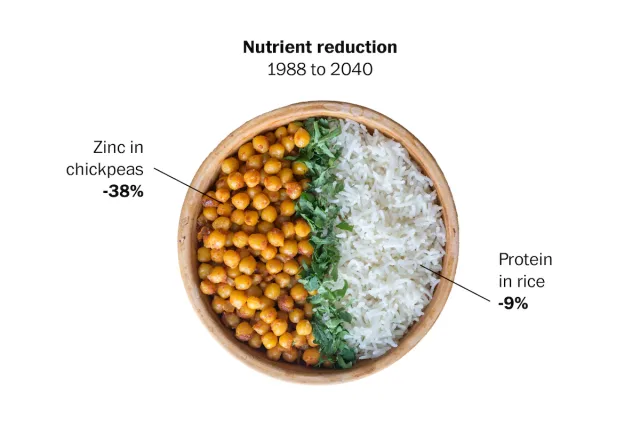
The degree of nutrient dilution varies widely between species. Between 1988 and 2040, zinc concentrations are projected to decline almost 40 percent in chickpeas but will barely change in other beans. Meanwhile, calcium concentrations are expected to rise in rice even as the nutrient dwindles from other crops.
Immune system problems linked to zinc deficiency are thought to cause nearly half a million excess child deaths each year from illnesses that are usually treatable, such as diarrhea and pneumonia. Women with severe anemia are seven times more likely to experience life-threatening bleeding during labor, according to a clinical study of more than 10,000 pregnancies, and their babies are more likely to suffer health problems or die soon after birth.
These deaths could be easily avoided if patients had better access to health care and good nutrition