AI Literacy Starts With Reading Books, Not Prompts
Dr Sam Illingworth
We need to focus on reading and critical thinking before learning how to use AI. Libraries help build these skills by offering free access to diverse books that teach judgment and empathy. The best way to handle AI is with a library card, not just new technology courses.
17 Jul 2026
The conversation about AI literacy has leapt straight to prompt engineering and responsible use without asking whether the person at the keyboard has the critical literacy to evaluate what the machine produces. You cannot assess AI output if you have never learned to assess an argument. You cannot spot a hallucinated citation if you have never read the real thing.
Reading is the infrastructure. Everything else is built on top of it.
When you read a novel, you practise sustained attention. You hold a character’s contradictions in your mind without resolving them. You sit with ambiguity for hours, not seconds. You encounter a world that was not generated for you, that does not adapt to your preferences, that asks you to meet it on its own terms.
When you read a difficult piece of non-fiction, you build the muscles of evidence assessment. You learn to distinguish between a claim and its support. You notice when an author is hedging, when they are asserting without evidence, when they are asking you to feel rather than think.
Critical literacy is not a specialised skill
There is a phrase in education: ‘reading across the curriculum.’ It means that reading is not the English department’s responsibility. It belongs everywhere. Every subject builds on the ability to read, interpret, and question a text.
The same is true for AI. Critical AI literacy is not a technology skill. It is an extension of critical literacy. The person who can read Toni Morrison closely, who can sit with the dissonance of a Claudia Rankine poem, who can follow a David Graeber argument across 500 pages and identify exactly where they disagree, that person is better equipped to evaluate AI output than someone who has taken every prompt engineering course available.
Libraries are the original open-access technology. Free to use. Open to everyone. No algorithm deciding what you see. No subscription required. No data collected. No engagement metrics shaping what gets surfaced.
They are one of the few remaining public spaces where you can think slowly, borrow freely, and encounter ideas you did not ask for. A library does not optimise your reading. It lets you wander. That wandering is where the unexpected connections happen, the ones no recommendation engine would have made.
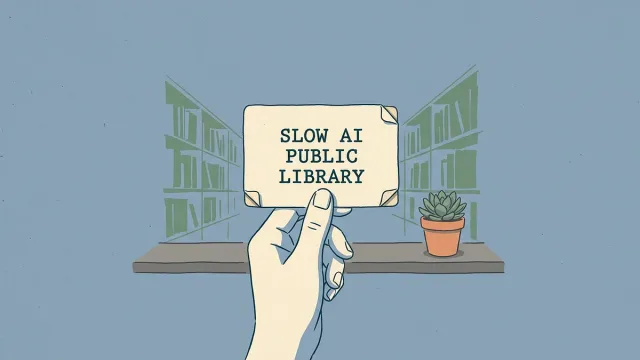
The Slow AI Public Library asks you three questions about how you use AI, what worries you about it, and what you have not made time for lately. Then it prescribes you a book. Not an AI book. A book that builds the skills AI erodes: judgement, empathy, patience, close reading, the ability to hold not-knowing.