A Therapeutic Journey
Alain de Botton
Life is often filled with pain and sadness that we tend to face alone. We can find comfort in connecting with others who share similar struggles. By acknowledging our difficulties and practicing kindness, we can build a supportive community that helps us cope with life's challenges.
16 Mar 2025
A healthy mind combines an appropriate suspicion of certain people with a fundamental trust in humanity. It can take an intelligent risk with a stranger. It doesn’t extrapolate from life’s worst moments in order to destroy the possibility of connection.
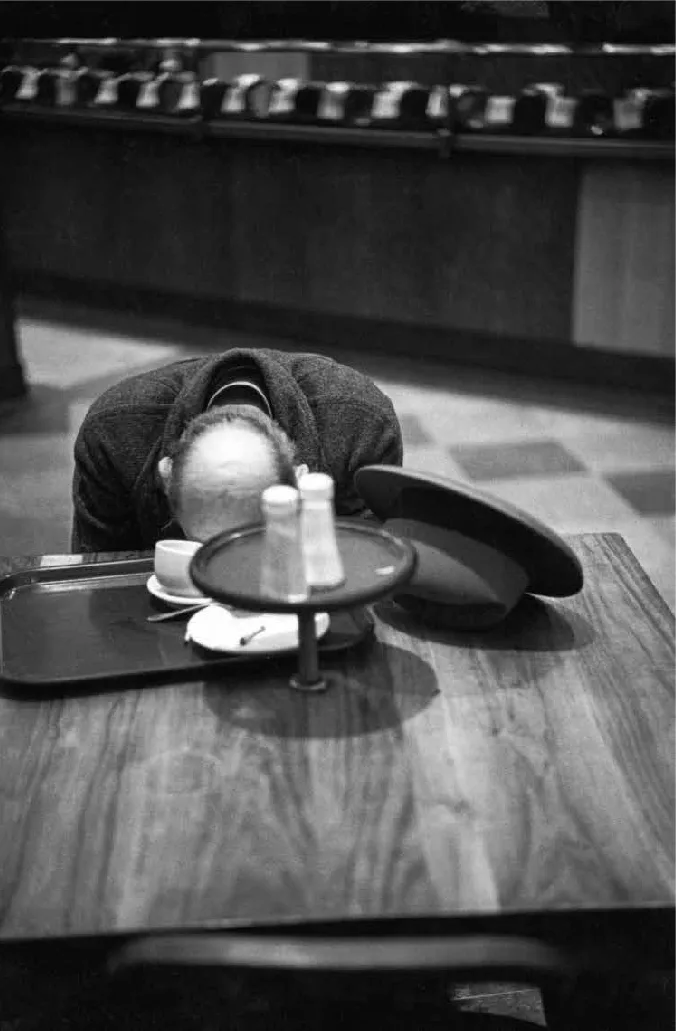
Except that there was a French photographer right opposite who was very much into noticing everything: an elegant, willowy man, with a name impossible for Americans to pronounce—he invited them to call him Harry—and a Leica 35 around his neck. Henri Cartier-Bresson had wandered the area all morning; he’d shot a group of women chatting outside on Ground Street and discovered a striking view of midtown Manhattan from the promenade. He had just begun his lunch when, without warning, there came that distinctive bang of a head hitting a table with force.
We need not feel ashamed, the photograph suggests, that we are in despair; it is an inevitable part of being alive. The distress that normally dwells painfully and privately inside our minds has been given social expression—and no longer needs to be shouldered alone. Whatever a distressingly upbeat world sometimes implies, it is normal, very normal, to be in agony. We don’t, on top of it all, ever need to feel unique for being unwell.
Henri Cartier-Bresson, A Café, 2nd Avenue, Brooklyn, NYC, USA, 1947.
It is a sign of the supreme wisdom of small children that they have no shame or compunction about bursting into tears. They have a more accurate and less pride-filled sense of their place in the world than a typical adult: They know that they are only extremely small beings in a hostile and unpredictable realm, that they can’t control much of what is happening around them, that their powers of understanding are limited, and that there is a great deal to feel distressed, melancholy, and confused about.
As we age, we learn to avoid being, at all costs, that most apparently repugnant—and yet in fact deeply philosophical—of creatures: the crybaby. But moments of losing courage belong to a brave life. If we do not allow ourselves frequent occasions to bend, we will be at far greater risk of one day fatefully snapping.
If we have properly sobbed, at some point in the misery an idea—however minor—will at last enter our mind and make a tentative case for the other side: We’ll remember that it would be quite pleasant and possible to have a very hot bath, that someone once stroked our hair kindly, that we have one and a half good friends on the planet and an interesting book still to read—and we’ll know that the worst of the storm may be ebbing.
If there is any advantage to going through a mental crisis of the worst kind, it is that—on the other side of it—we will have ended up choosing life rather than merely assuming it to be the unremarkable norm. We, the ones who have crawled back from the darkness, may be disadvantaged in a hundred ways, but at least we will have had to find, rather than assumed or inherited, reasons why we are still here. Every day we continue will be a day earned back from death, and our satisfactions will be all the more intense and our gratitude more profound for having been consciously arrived at.
The steps we need to take in order to check in with ourselves are not especially complicated. We must make time, as often as once a day, to lie very still on our own somewhere, probably in bed or maybe in the bath, to close our eyes and direct our attention toward one of many tangled or murky topics that deserve reflection: a partner, a work challenge, an invitation, a forthcoming trip, a relationship with a child or a parent. We might need a moment to locate our actual concern. Then, disengaged from the ordinary static, we should circle the matter and ask ourselves with unusual guilelessness: What is coming up for me here? Holding the partner, work challenge, invitation, or disagreement patiently in mind, we should whisper to ourselves: What do I really think? What is the real issue? What is truly going on? What is actually at stake?
We are sometimes like a high-powered aeroplane that can be grounded because a small screw is missing. We should be humble in the face of the ostensibly simple things that can ruin our lives.
With this caveat, we should step outside the ordinary flow of the anxious day for a moment, close our eyes, take a deep breath and ask ourselves this: What am I really worried about right now?
To take on the past, we don’t need to be driven by a preternatural enthusiasm for self-exploration, we don’t need to be self-pitying or dementedly furious with parents who were only trying to do their best. All that is required is a weary, dutiful realization that the principal way to overcome our history is to address it. We should try to remember not out of nostalgia, but in order to be able to forget, once and for all.
The vulnerability is both touching and—when you remember how damaged certain adults are—appalling. You can do anything with little people. Tell them you are their friend and then burn their hand, give them a lollipop and then separate them from their parents, whisper to them late at night that no one must ever know about this and ruin them for life. It sounds highly disturbing and it is.
We were those little people once. We aren’t any longer. We know the ways of the world. We’re tall and our voices carry. We can think freely. But this was once us—and the distortions of those years have a habit of remaining embedded within our minds for a long time, beneath a substratum of maturity. We owe it to ourselves to take a very patient look at what might have happened to us before we knew who we were.
First, and most importantly, a competent parent is someone who can feel inordinately pleased that their child has come into the world—and never ceases to remind themselves or their offspring of the fact, in direct and indirect ways, at small and large moments, pretty much every day. There is no risk of spoiling anyone by doing so: Spoilt people are those who were denied love, not those who had their fill of it.
Nevertheless, given how long we were exposed to them and at what formative stages, our parents may have left more of a mark on us than we normally recognize and may be constantly commenting on our lives from inside like a chorus of unhelpful marionettes.
We might go so far as to say that anyone who has ever suffered from mental illness and who recovers will do so—whether they consciously realize it or not—because of an experience of love. And, by extension, no one has ever fallen gravely mentally ill without, somewhere along the line, having suffered from a severe deficit of love. Love turns out to be the guiding strand running through the onset of, and recovery from, our worst episodes of unwellness.
In such agony, a loving companion can make the difference between suicide and keeping going. Such companions do not try to persuade us of our worth with cold reason; nor do they need to go in for any showy displays of affection. They can just demonstrate that we matter to them in a thousand surreptitious yet fundamental ways. They keep showing up by our bed day after day, they make pleasant conversation about something that won’t in any way make us anxious, they’ve remembered a favorite blanket or a drink, they know how to make a few jokes when these help, and they suggest a nap when they feel us drifting away. They have a good sense of the sources of our pain, but they aren’t pushing us for a big conversation or confession. They can tolerate how ill we are and will stick by us however long it takes. We don’t have to impress them and they won’t worry too much about how scary we are looking or the weird things we might say. They’re not going to give up on us. The disease might take a month or six years or sixty, but they’re going nowhere. We can call them at strange hours. We can sob or we can sound very adult and reasonable. They seem, remarkably, to love us in and of ourselves, for who we are rather than anything we do. They hold a loving mirror to us and help us to tolerate the reflection. It’s pretty much the most beautiful and useful thing in the universe.
We are the insane ones and they will always fly the flags of health, rationality, and balance. They feel sorry for us from afar: We are the proverbial drowning man and they the observer on dry land.
Loving companions bear no such hints of superiority. They do not judge us as beneath them when we lie crumpled in our pyjamas at midday because they do not fundamentally see themselves as “above” someone who has fallen through the floor of sanity. We may happen to be very ill at the moment, but it could just as easily have been them if not for the accidents of psychology and of neurochemistry.
It might seem highly patronizing to tell an adult that they need to be reparented. In fact it’s the height of maturity to recognize that the small version of us must, if we’re ever to get better, allow ourselves another chance to experience what it could feel like to matter limitlessly to a kindly companion.
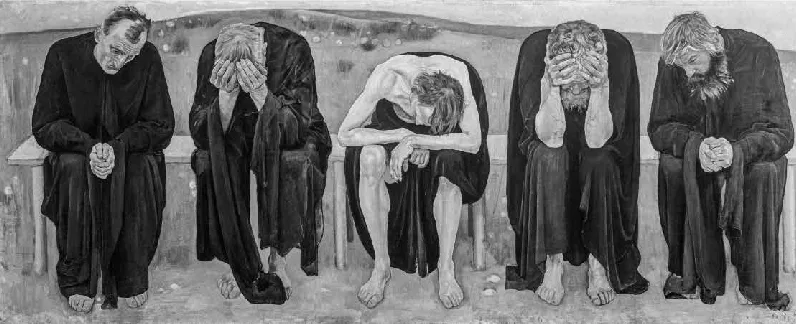
Ferdinand Hodler, The Disappointed Souls, 1892.
Hodler wasn’t painting any one scene. He intended his work as an allegory of modern society as a whole, with its absence of community, its lonely cities and its alienating technologies. But in this very depiction lies the possibility of redemption. We will start to heal when we realize that we are in fact always extremely close to someone who is as wretched as we are. We should therefore be able to reach out to a similarly broken neighbor and lament in unison. We should learn to come together for a very particular kind of social occasion the whole focus of which would be an exchange of notes on the misery and lacerations of existence.
The psychoanalyst Donald Winnicott made a distinction between what he termed a “true” and a “false” self. In order to be healthy, a baby and developing child needs to be allowed to express and experience its true self: that is, it has to be honest about its actual wishes and desires, without fear of censorship or any pressure to compromise. If it is feeling furious, it should have a tantrum. If it’s sad, it should weep. If it’s envious, it should gnarl. It should be allowed the luxury to express its genuine emotions in all their raw intensity. Later on, of course, the child will have to be taught about manners and the feelings of others. Gradually, but only gradually, it will be shown the way to adopt—at points—a false self that knows how to smile, say thank you and not let on about its disagreements. But only if the true self has had its say for a good long while can development be healthy—and Winnicott knew that too many of us are wandering the world without having had the chance to be appropriately awkward and tricky with others before the demand to be polite set in. Going “mad” for a while may be our attempt to return to some of the feelings that we had to surrender too soon in the name of not angering or upsetting parental figures.
We may never have revealed to anyone the peculiar arguments that reverberate inside us and make us feel so hemmed in. But speaking these arguments aloud to an outsider can help us to see their absurdity and cruelty—and ultimately break their unwarranted spell over us.
Whereas past ages resigned themselves to offering modest destinies to most of their citizens, modernity has insisted that everyone—whatever their background or families of origin—should be capable of realizing the most stellar feats. No longer should anything—education, background, race, creed—stand in the way of ambition.
This has been in its way an incomparably generous philosophy. But it has also, in the background, set up the ideal preconditions for mental instability. It is one thing to promise us all a chance of success, it is another to hint—as our era constantly does—that a modest destiny is essentially unacceptable. While praising lives of outsized accomplishment, our era has thrown a shadow over the ordinary lives that most of us will by necessity continue to lead. The norm has ceased to be enough. We cannot be average without at the same time having to think of ourselves as being what our age resents above all else: losers.
The burden of personal responsibility grows exponentially and explains why this age has seen a corresponding increase in rates of suicide, since the blame for a life that has gone awry can only reside narrowly within each of us.
To further aggravate our emotional woes, modernity has cast aside what had been, since the dawn of time, a central resource for coping with life’s vicissitudes. God has died and there is now little we can turn to, intone in front of, or beg for deliverance from when times grow hard. We dwell in a world ruled by the pitiless laws of science in which relief is on offer only from psychotherapists or psychiatric doctors, who equate our problems narrowly with our own personal histories and biology. It feels, for most of us, impossible to weep in temples and churches. We scour the universe for clues as to why we are here and what we are meant to do with our troubles, and hear back only static and silence.
We have grown ever more capable of subsisting without others. We can endure for days in cities of 10 million people without uttering a word. Yet we have lost the art of admitting our sorrows to others and of building connections based on vulnerability. We are lucky if we can lay claim to even one or two people we can call on when disaster strikes.
Our age attempts to cure loneliness through romantic love with the promise that we may, each of us, find one very special person to whom we can tie ourselves for life and who will spare us the need for anyone else. But this emphasis serves only to aggravate our isolation and renders our relationships more fractious than they should be, for no single person, however extraordinary, can ever replace our need for a more broadly based circle of support.
Once we have properly surveyed the merits and demerits on offer, we may willingly choose to side with what the modern age typically considers to be a disaster: a quiet life. This is not from any lack of ambition, but from a more focused aspiration for what we now recognize to be the primordial ingredient of happiness: peace of mind.
We will have liberated ourselves from the madness of the age when we can look on loud and heroic lives—perhaps led by people we once knew—and with good faith say that this is not for us, that we are happier where we are, because we at last understand what we really require to survive mentally: cosiness, connection, and an ongoing lack of drama.
We can blame ourselves too much for our mental suffering. It is not that we are personally fragile but merely that we are living in a high-tech age that routinely smashes its more sensitive members to pieces through adherence to what will one day be recognized as a grossly primitive and unimaginative ethos.
And when we panic and feel intensely anxious about the future, we need to remember that we are in essence worrying about our fundamental legitimacy and lovability. Our survival depends on a swift mastery of the varied arts of self-compassion.
While thinking through our problems is crucial to our health, to attempt to think without enough sleep is worse than not thinking at all. The thinking we do when tired is vindictive and sloppy. It misses important details, gives the advantage to our enemies, and hands victory to the evangelists of sadness.
Understanding our vulnerability, we should never take seriously any worry that suddenly appears extremely pressing after ten in the evening. What we panic about in the early hours should automatically be discounted. No large conversation or argument should ever be undertaken past nine o’clock.
Being careful doesn’t just apply to the night. At varied points in the day, when we are overwhelmed, we should know to stop and hoist a white flag. It may look as if we should keep trying to fight our demons. In fact, we need to sidestep them with a nap. We may feel guilty, but it is lazier and more irresponsible to try to keep going than it is to know the game is up for now.
Not thinking consciously should also be deemed a part of the mind’s work. Being curled up in bed allows our minds to do a different sort of thinking, the sort that can take place when we are no longer impatiently looking for results, when the usual hectoring conscious self takes a break and lets the mind do what it will for a time. It is then, paradoxically, that certain richer, more creative ideas can have the peace and freedom to coalesce, as they may do when we are out for a walk or idling in a cafe. Thinking isn’t what we do best when it’s all we’re meant to do.
We may have to go back as far as childhood to ask: What did I really enjoy doing? When did I feel most alive? There may be clues to what our future should be in the way we used to play as small children, when impressing and earning money were far from our minds.
There are, in reality, only a small number of fundamental factors that account for the well-being of every robust, loving couple. Though relationships might seem infinitely varied, whether they succeed or fail comes down, in essence, to the presence—or absence—of five anchors.
“Love me for who I am” is the fateful rallying cry of all lovers headed for disaster. It is in reality a monstrously unfair—though entirely understandable—demand to be loved just as we are, with our panoply of faults, compulsions, neuroses, and immaturities. But with a modicum of self-awareness and honesty, we should only ever expect to be loved for who we hope to be, for who we are at our best moments, for the good that lies in us in a latent and not-yet-realized state.
The spirit of true love should require that whenever there is feedback, we turn gratefully to our partner and ask for more, that we continuously search to access a better version of ourselves, that we see love as a classroom in which our lover can teach us one or two things about who we should become—rather than as a burrow in which our existing errors can be sentimentally endorsed and encouraged.
Defensive people did not magically acquire their ferocity in relation to our comments, but rather suffered from some form of early neglect or encounter with unsteady, fluctuating warmth. No wonder that such a person might respond with alarm, even viciousness, when the slightest negative thought about them rears its head in a lover they felt ready to entrust with their whole being. There could, in the mind of the unfortunate sufferer, plainly be no such thing as affectionate criticism, no such thing as helpful feedback, no possibility of being at once adored and upbraided.
Eventually, with a lot of effort, we would hope to reach the stage when a partner could point out with tact and humanity that we had bad breath or that our shoes didn’t match our sweater and, rather than reacting as we have grown up to do, we could simply turn to them, smile benignly and say what flawed humans should always respond with when another member of the species deigns to help them to grow into a better version of themselves: Thank you.
To dare to be vulnerable involves a faith that whatever we are inwardly most afraid and ashamed of in our own natures must have counterparts in other people. We cannot be alone in our oddities and our symptoms. The only people we can assume are “normal” or “sane” are those we don’t yet know very well. But once we are past the flawless exterior, every person we meet—and especially the person we are now dating—will have their share of follies and tender spots: they will be unable to temper their panic, they will fear disgrace, they won’t remember how to soothe themselves. We are guaranteed not to be alone in our terrors and neediness. And what is more, it’s only on the basis of mutual disclosure of susceptibility that a true bond can be built. We may admire paragons of strength and stoicism; we can never properly love them.
Honest, vibrant love is an encounter between two vulnerable children who otherwise do a very good job of masquerading as adults.
Finding a partner with whom we can be vulnerable constitutes a supreme act of restoration. After a lifetime of denial and false strength, we stand to find in another the sympathy that was sorely needed but unavailable to us in the past. The old wounds can be gently tended; we become stronger by learning to speak the language of weakness. By letting our hurt, mentally fragile selves into the relationship, we open the way to a more nuanced, fruitful, creative, and accurate way of being an adult.
At the core of the tender person’s outlook is a simple-sounding but love-sustaining fact: they treat the other as no less fragile, flawed, and sensitive than they remember themselves to be—only around slightly different things.
The essence of psychotherapy lies in a willingness to get systematically interested in why we constantly respond in the bizarre and uncalled-for ways we exhibit. It asks by what sequence of formative experiences an otherwise perfectly decent and intelligent person could be led to sob on the floor or threaten to jump out of the window after an argument. It’s less disturbed by a tantrum, a sulk, or a cold withdrawal than curious about where such over-or under-reactions might be coming from.
We grow appropriately therapeutic when we can be genuinely interested in the long history that might be standing behind the least alluring and at times appalling emotional conduct of which we and our partners are capable. As therapeutically minded lovers, we no longer always ask why they are being so horrible to us, we try to work out what other people might long ago have done to and around them.
What counts, though, isn’t that the therapist has developed an accurate diagnosis but that the patient is allowed to recognize it for themselves, by a process of carefully designed prompts, in a way that they can absorb without fear, in their own time. That is why therapists tend to proceed via gentle questions—“I wonder how it felt when Mom went away”—instead of blanket assertions: “Let me tell you why you are so messed up.”
Everyone, during the close-up, prolonged inspection all relationships entail, is sure to reveal themselves as being substantially disturbed. Which is why we so much want and need to be with someone who grasps, with reference to the complexities of our early emotional lives, the essential normality of our oddities. They might win our hearts by saying, on an early date: “I’ll tell you about how mad I am, and where it all began, if you’ll tell me how crazy you are, and how Mom and Dad messed you up.” We’ll thereby be deploying the possibilities of a therapeutically minded perspective to help secure the long-term sympathetic love we are looking for.
Anger creeps into love and destroys admiration. We cease to delight because we unknowingly grow entangled in various forms of unprocessed annoyance. We can’t cheer them on because, somewhere deep inside, we are inhibited by trace memories of certain let-downs, large and small, of which they have been guilty without their knowing.
If couples too often ignore the requirement, it is because they operate under an unfair burden of bravery: they are far more susceptible than they let themselves think. They assume that it cannot be sane to get “upset” so often, to experience so much hurt, to be so easily ruffled. They can’t summon the courage to make a complaint about things that they don’t even admit to themselves have caused a sting—and so stay silent until it is no longer possible for them to feel. Wiser couples know that nothing should ever be too small to cover at length, for what is ultimately at stake in a marathon conversation about a single word or a minuscule event in the hallway can be the fate of the entire relationship. These lovers are in this sense like wise parents who, when a child is sorrowful, are patient enough to enter into the imaginative realm of the child and take the time to find out just how upsetting it was that there was a loud bang in the street or that one of Nounou’s eyes came off. They will devote three and a quarter hours to understanding why a partner got silently immensely upset by the way we said the word “ready” to them at breakfast the day before or how it felt to them when we were a touch slow at laughing along with a mildly unfunny story they shared about a train and a suitcase at dinner with our aunt. The gratitude that will flow from such an effort to understand them will be amply repaid the next time we feel abandoned because they forgot to put the lid back on the olives or omitted to add a second x at the end of an email.
To complain in love is a noble and honorable skill very far removed from the category of whininess with which it is sometimes confused. The irony of well-targeted and quickly raised complaints is that their function is entirely positive. Honesty is a love-preserving mechanism that keeps alive all that is impressive and delightful about our partner in our eyes.
We would at such points be advised to lean on a technique pioneered and much favored by psychotherapy known as “reflective listening.” The theory behind it is that an important share of our most serious problems have no solutions in any practical sense. There are simply no “answers” to losing lots of money, being excluded from a social circle, or failing in a job.
What psychotherapy realizes is that, in our agony, what we desire more than anything, more than we usually even understand, is companionship: for someone else to know that we are suffering and to feel a measure of our pain more or less as we experience it. We yearn to feel that another person appreciates the scale of our despair and the magnitude of our sense of injustice, while at the same time being deeply suspicious of, and alert to, anyone who might too hastily be trying to make our distress go away.
Having fathomed our longing, psychotherapy introduces a key innovation: it proposes a way of behaving around a person who is incensed or sad that can give them a strong feeling that they are being understood. Saying “I know” or “oh yes” won’t—as psychotherapy knows—be quite enough. What we need to do instead is to paraphrase what our ailing companion has said, to build sentences that repeat back to them the essence of the difficulty they have expressed but in different words. This form of precis deftly signals two things: first, that we have precisely grasped what they have gone through, and second, that we have been doing more than listening passively.
The genius of reflective listening is that, on the basis of paraphrasing alone, we can leave our speaker appeased and becalmed. Without anything ostensibly changing, the incensed or sad person’s levels of fear and irritation ebb. The squall passes; hope returns. This teaches us just how much “solutions” may ultimately be overrated. All that we are chiefly in search of when we are at our lowest point is evidence that we are in company.
A more evolved relationship to ourselves—of the kind psychotherapists seek to promote—can assuage the itch to deliver upbeat messages by prompting us to make our peace with sorrow. Someone might say that they are sad and we could in time learn simply, and more helpfully, to answer, “I hear you.” Another might insist, “Everything is awful,” and we might look them warmly in the eye and respond, “Yes, it really can feel like that at times.”
Feelings get less strong, not stronger, once they’ve been acknowledged. It is a move of exemplary generosity and maturity to let someone be sad and desperate around us without falling for the cruel temptation of saying something cheerful.
An idea of ours may be entirely correct, but the directness with which we attempt to insert it into another’s mind can lead them to recoil and reject it almost as a matter of course, with violence and outrage. The truth, if ever it is to reach another’s consciousness, has to travel in the softest, most hesitant layers of doubt.
They hence opt for digestible suggestions over thunderous generalizations: “I feel you’re withdrawing somewhat . . .” over “You’re in denial”; “I feel you might be a touch angry . . .” over “You’re in a rage.” They know that there is a vast difference between “You’re wasting your time” and “I feel you might no longer be getting the results you need . . .”; between “Don’t always blame other people” and “I feel you might be tempted to hold your friend responsible . . .”
A central way to disarm the danger of suffocating others with reality is therefore to resist the urge to tell them what we suspect is wrong with them. Whatever the provocation and however late the hour, we must never sink to giving out overly direct diagnoses or grand summaries of their condition. There is strictly no point in saying, “It all comes down to your father . . .” or “You’re afraid of intimacy . . .”
It is a bathetic but unavoidable reality of human nature that what can separate our absorption of a truth from its angry and incensed rejection may be nothing more or less than a very small, soft, gossamer-light yet entirely crucial “maybe.”
As therapy sees it, the chief difficulty is not to identify someone’s problem but to help them see, feel, and accept it. Were the truth to be baldly laid out before most clients, they would leave at once in a mood of incensed fury
Therapy knows that there are few loving mothers who do not, at points, wish their babies dead. And few respectful, affectionate children who do not fantasize that their parents might be annihilated, if only for a while. It knows, too, that it’s wholly normal to love someone and fantasize about having sex with someone else; or to completely forget why we ever committed to a partner only to recover the thread of our story a few hours later. Therapy is unbothered by the strangeness of our disloyal and entangled feelings. It knows that we are all a good deal stranger than we’re allowed to admit and it lets us be as unconventional as is helpful without judging or taking fright.
With the example of therapy in mind, we’ll be less upset by squalls, less frightened of viciousness, and better able to hear with wry patience that we are apparently a shit-faced bastard who ruined someone’s life—only, ten minutes later, to hear an addendum that we are also someone our partner will love to eternity. Anger and irritation don’t destroy love; they are inevitable parts of being genuinely close to and extremely dependent on another human being.
A therapeutic attitude taps into a proper recognition of the many contradictions of the mind. It prepares us for the fact that, if we are ever to make a good shared life together with someone, we’ll have no option but to confront and accept—and in the end finally love—the infinitely strange and wondrous complexity of a fellow human.
But we will, of course, never arrive. There is no true destination and there is definitely no end point. All there is is the journey—an idea which, though it has its tragic dimension, liberates us to make more of the true valuable increments of life: moments.
One of the unexpected origins of something as serious and consequential as adult mental health arguably begins right here. If we find ourselves as grown-ups feeling creative, knowing how to appreciate ourselves, understanding how to remain calm, and ready to give affection to others, it is almost certainly because at some point, a long way back, someone did for us what the woman in Vrel’s painting is doing for the little girl: gave us attention, made us the focus of tenderness, appreciated us on our own modest but vital terms.
Children who end up sane have been spared the need to be very good or very reasonable too early.
17 Mar 2025
We don’t actually ever need the whole of society to love us. We don’t have to have everyone on our side. Let the Robert Greenes of this world—and their many successors in newspapers, living rooms, and social media down the ages—say their very worst and nastiest things and be done with them. All that we need is the love of a few friends or even just one special person and we can survive.
Because our lives are so brief it is the quality of our experiences, rather than the extent of our possessions, that matters. The more things we own, the more we are exposed to random misfortune: A fashionable home will soon be dated; our prestige in the eyes of others will fluctuate for trivial reasons; we might build a palace and die before it is completed; and the monuments we hope will allow our names to last get misinterpreted or torn down.
The Greeks knew that the more rational we usually are, the more important it is—at points—to fling ourselves around to the wild rhythms of pipes and drums. At the festivals of Dionysus, held in Athens in March every year, even the most venerable and dignified members of the community would join in with unrestrained dancing that, irrigated by generous amounts of red wine, lasted until dawn.
It’s a privilege to allow a child to manifest their frustration and not all parents are game. Some are very keen on having a “good baby.” They let the infant know from the first that being “naughty” isn’t funny and that this isn’t a family where children are allowed to “run rings around” the adults. Difficult moods and tantrums, complaints and rages are not to be part of the story. This certainly ensures short-term compliance, but paradoxically, preternaturally good behavior is usually a precursor of bad feelings, and in extremes of mental unwellness, in adulthood. Feeling loved enough that one can flip off parental figures and occasionally fling something—soft—across the room belongs to health; truly mature parents have rules and allow their children sometimes to break them.
At work, an unwavering concern for politeness, empathy, and gentleness may end up providing the perfect preconditions for being walked all over.
We need to relearn the neglected art of politely, on necessary occasions, being a pain. The danger of those who have never shouted is that they might, in compensation, end up screaming. That isn’t the point either. The goal is a firm but self-possessed protest: Excuse me, but you are ruining what’s left of my life. I’m so sorry, but you are cauterizing my chances of happiness. I beg your pardon, but this is enough . . .
The timid always imagine that anger might destroy everything good. They overlook, because their childhoods encouraged them to, that anger can also be a fertilizer from which something a lot less bitter and a lot more alive can emerge.
19 Mar 2025
Those who can’t lay down boundaries have invariably not, in their early lives, had their own boundaries respected. Someone didn’t allow them to say when they were unhappy with a genuinely difficult situation; someone didn’t give much of a damn about their hurt feelings or distinctive hopes; someone insinuated that being good meant falling in line, always, immediately. No one modeled the skill of winning, graceful objection.
People almost never hate those who make polite and reasonably framed demands; in fact, they tend to respect and like them a little more. They feel in the presence of a maturity and kindly authoritativeness that appear worthy of their time, as well as seeming rare and a bit thrilling. Frustrating someone’s wishes doesn’t have to be evidence of selfishness; it may signal a noble concern for another’s long-term well-being and flourishing. We can adore someone, wish them the very best, have the kindest intentions toward them—and still, very diplomatically and yet very decisively, tell them no.
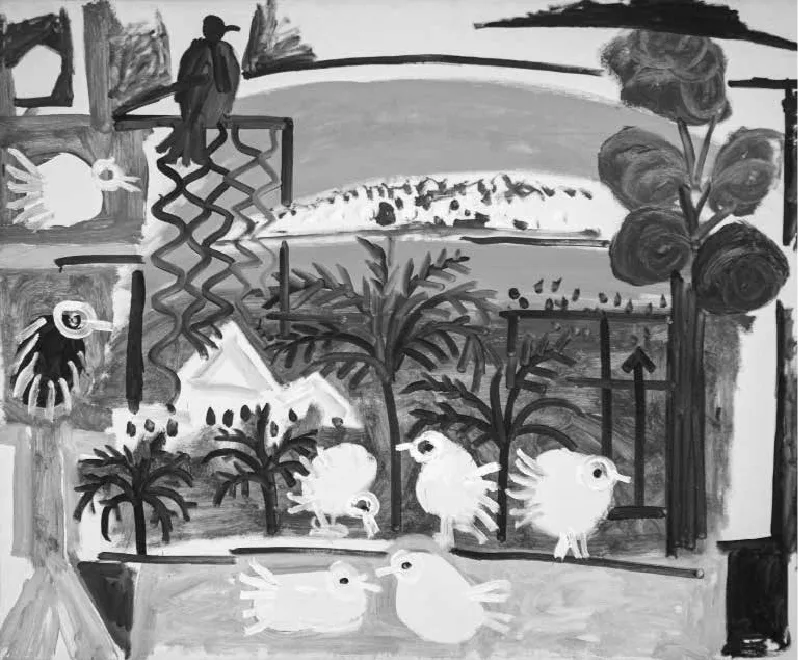
Poignantly, on a tour of a primary school an ageing Picasso once said, “At their age, I knew how to paint like Titian. It’s taken me a lifetime to remember a greater achievement: how to paint like a child.” What he meant was that it had taken him decades to shake off a compliant urge to paint “well” and “respectably” and to listen instead more closely to his own sense of fun—which is a serious business not to be confused with its lesser sibling, frivolity. Pushed by mortality into a new respect for his own centers of pleasure, Picasso had learned how to overcome every trace of the mannered approach of his youth in order to focus instead on the joy of decorating a canvas with the loose brushstrokes, exuberance, and bold colors well known to those natural artistic masters: five-year-old children.
When he was fourteen: Pablo Picasso, Academic Study, 1895.
When he was seventy-six—and had finally remembered to listen to his boredom: Pablo Picasso, The Pigeons, 1957.

One of the most basic facts about time is that, even though we insist on measuring it as if it were an objective unit, it doesn’t, in all conditions, seem to be moving at the same pace. Five minutes can feel like an hour; ten hours can feel like five minutes. A decade may pass like two years; two years may acquire the weight of half a century. And so on.
The difference in pace is not mysterious but has to do with novelty. The more our days are filled with new, unpredictable, and challenging experiences, the longer they will feel. And, conversely, the more one day is exactly like another, the faster it will pass by in a blur. Childhood ends up feeling so long because it is the cauldron of novelty; because its most ordinary days are packed with extraordinary discoveries and sensations.
We must go to Machu Picchu or Angkor Wat, Astana or Montevideo; we need to find a way to swim with dolphins or order a thirteen-course meal at a world-famous restaurant in downtown Lima. That will finally slow down the cruel gallop of time.
But this is to labor under an unfair, expensive, and ultimately impractical notion of novelty: that it must involve seeing new things, when in fact it should really involve seeing familiar things with new eyes. We may by middle age certainly have seen a great many things in our neighborhoods, but we are—fortunately for us—unlikely to have properly noticed most of them.
But of course we have barely scratched the surface. We have grown bored of a world we haven’t begun to study properly. And that, among other things, is why time is racing by.
We don’t need to make art in order to learn the most valuable lesson of artists, which is about noticing properly, living with our eyes open and thereby, along the way, savoring time. Without any intention to create something that could be put in a gallery, we could—as part of a goal of living more deliberately–take a walk in an unfamiliar part of town, ask an old friend about a side of their life we’d never dared probe, lie on our back in the garden and look up at the stars or hold our partner in a way we never tried before.